
Honey Bee Swarms
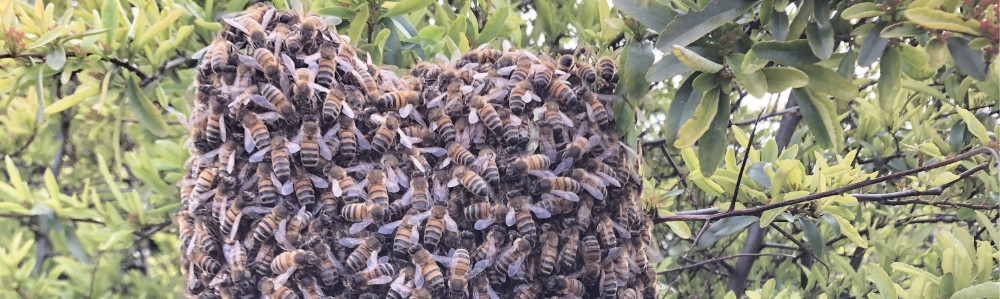
Swarming honey bees are one of nature’s true spectacles.
Somewhere in the middle of this large group of swarming honey bees is a Queen and they are all looking for a new home for her and for themselves.
To capture a swarm, capture the Queen and all the bees follow.
Simple, eh ?
You generally hear a swarm of honey bees before you see one, as the noise is always what people report as their first awareness of a honey bee swarm.
Honey bee swarms are remarkably nimble and can appear and disappear in a very short period, as the swarm pitches up in a tree or hedge, while it then sends out scouts to consider what new locations meet the group consensus for a new home. If the swarm can be “captured” at this point and proffered a welcoming pied-à-terre, in the form of a hive, the chances are they’ll stay put and go on to become useful and productive members of the community.
The swarming season is always a crazy, uncertain period, of indeterminate time, as beekeepers look to ensure swarms can be re-housed appropriately and cared for, to ensure that bees continue to do all that we know that they do, with the minimum of risk to themselves or impact on people.
Swarming is the manner in which a colony of bees will divide. For the bee colony that has made it through the winter, perhaps resident in a tree (or a hive), as Spring progresses, the colony will soon attain a level of population congestion and look to divide, allowing a group to move on elsewhere.
As the resident queen departs, with a following from the colony, she leaves behind a new, soon-to-emerge, queen (her daughter), who will take up the position of the new queen to those bees who remain, and take the colony forward for another year, repeating the process the following year… if she’s successful in perpetuating the colony. The challenge for the beekeeper is to read the signs and manage the bees such that they don’t swarm – not always easy. But for bees living in the wild, they will do what comes naturally, as and when they choose.
Any year’s swarming season could start in April, be in full flow during May and, in previous years, can go on through to July. In 2020, it started in March and ran through to September!!
Not all swarms can be successfully relocated, but that’s the challenge for the beekeeper. I’ve chased and retrieved the same swarm multiple times in an afternoon, only to find they have left again by the following morning. And I’ve retrieved a swarm late in the day and left them in the garage overnight, to come out the following morning to find a garage full of escapees! (Every beekeeper has their favourite swarming story.) However, if the bees cannot be easily retrieved, it might be that other options need to be considered. But, more often than not, a hedge can be cut back or a branch snipped, for them to be placed in a box for quick transfer to a (potential) new home.
As to any danger presented by a bee swarm, if you have a known allergy to insect stings then due caution must be applied. But bees in a swarm have nothing to defend, so (usually) offer no defensive reactions. However, it is possible that you could be stung by accident, as you collide with a pre-occupied bee.
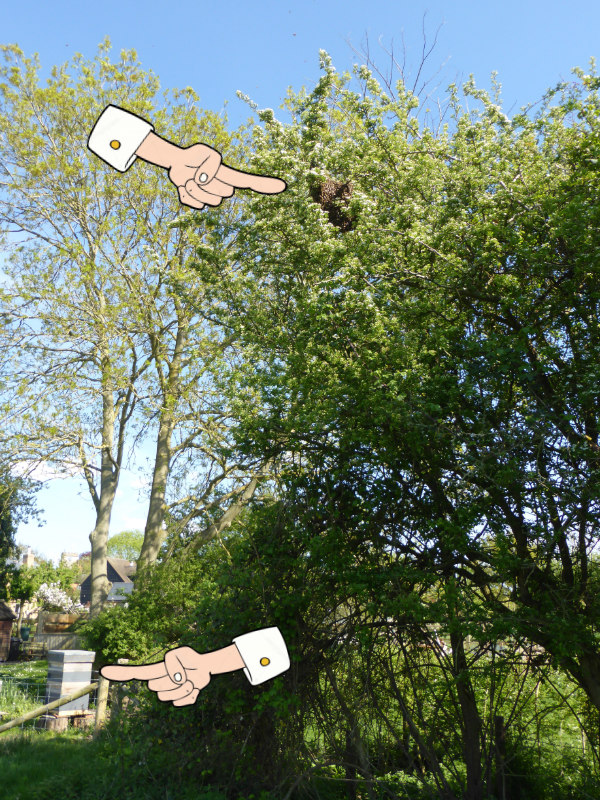
Not all swarms are readily accessible!
Who y'gonna call..?
Bee Busters!
The Bucks County Beekeepers Assoc. maintain a list of beekeepers locally in the Bucks County who you can contact directly. Please follow this link below to…
Please note:
Our members are volunteers, so please understand that there will be situations where our members may not be able to retrieve a swarm and a professional pest controller may still be required.
So, whilst a swarm of honey bees may look (and sound!) intimidating and angry, they are nothing more than eager house-hunters, excited to be looking for a new home. Approached correctly and in good time, honey bees can often be successfully captured to be re-homed into more appropriate accommodation.